The Sustainable Improvement Framework
Understanding where to start, why challenges occur and how meaningful improvement happens. Many organisations know what they want to improve. The challenge is understanding where to start.
Too often, quality improvement focuses on symptoms rather than causes. New training is introduced, action plans are created and systems are updated, yet meaningful and sustainable improvement does not always follow.
The Sustainable Improvement Framework was developed to help leaders understand the factors influencing quality, identify where misalignment may exist and focus improvement efforts where they are most likely to create meaningful change.
Why the framework was developed
Throughout my career, I have worked across early years, further education, workforce development and national programme delivery, supporting organisations to improve quality, develop their workforce and strengthen professional practice.
Despite working across different sectors and settings, I repeatedly encountered the same challenge. Organisations often knew what they wanted to improve, but struggled to identify where to start. New training was introduced. Action plans were created. Systems were updated. Yet meaningful improvement did not always follow.
What became clear was that many quality challenges were not caused by a lack of effort, knowledge or commitment. Instead, they often emerged when different parts of an organisation became disconnected from one another.
Leaders had a clear vision, but staff could not explain the priorities. Training was delivered, but practice remained unchanged. Policies were updated, but routines did not reflect them. Quality assurance activity increased, but impact remained difficult to demonstrate. These observations led to the development of the Sustainable Improvement Framework.
A different way of thinking about improvement
Many improvement approaches focus on identifying what is wrong and creating actions to fix it. The Sustainable Improvement Framework takes a different approach.
Rather than asking:
What should we do?
it asks:
What is really happening and why might this be happening?
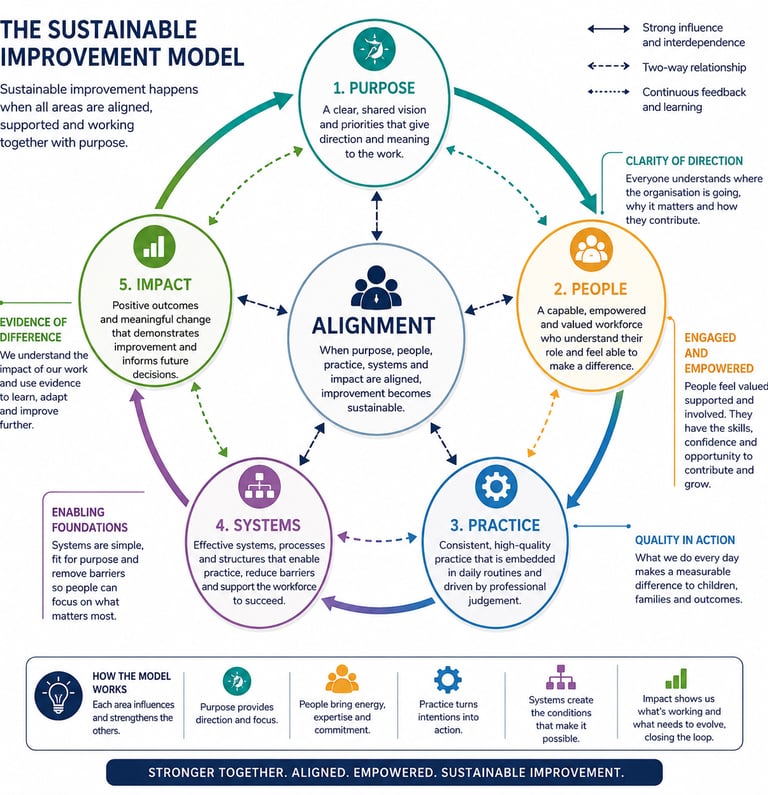
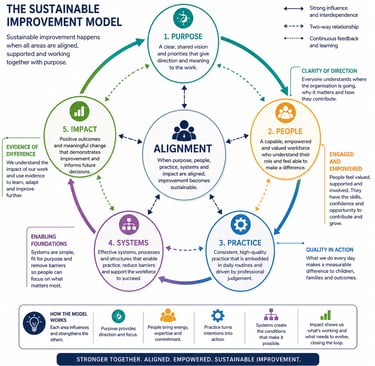
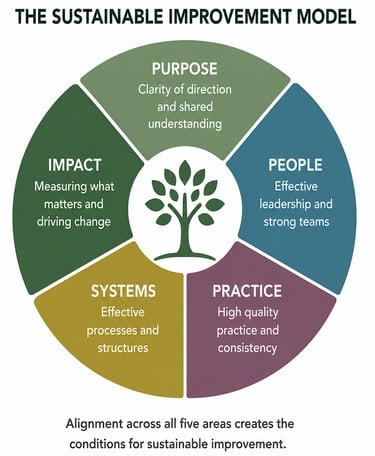
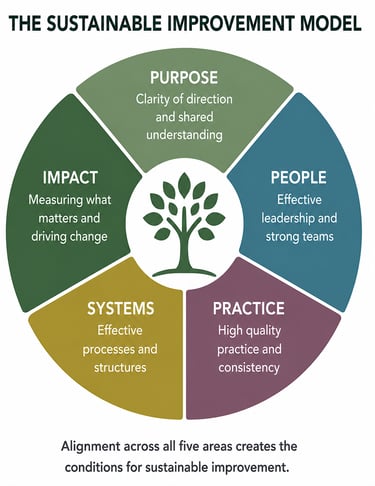
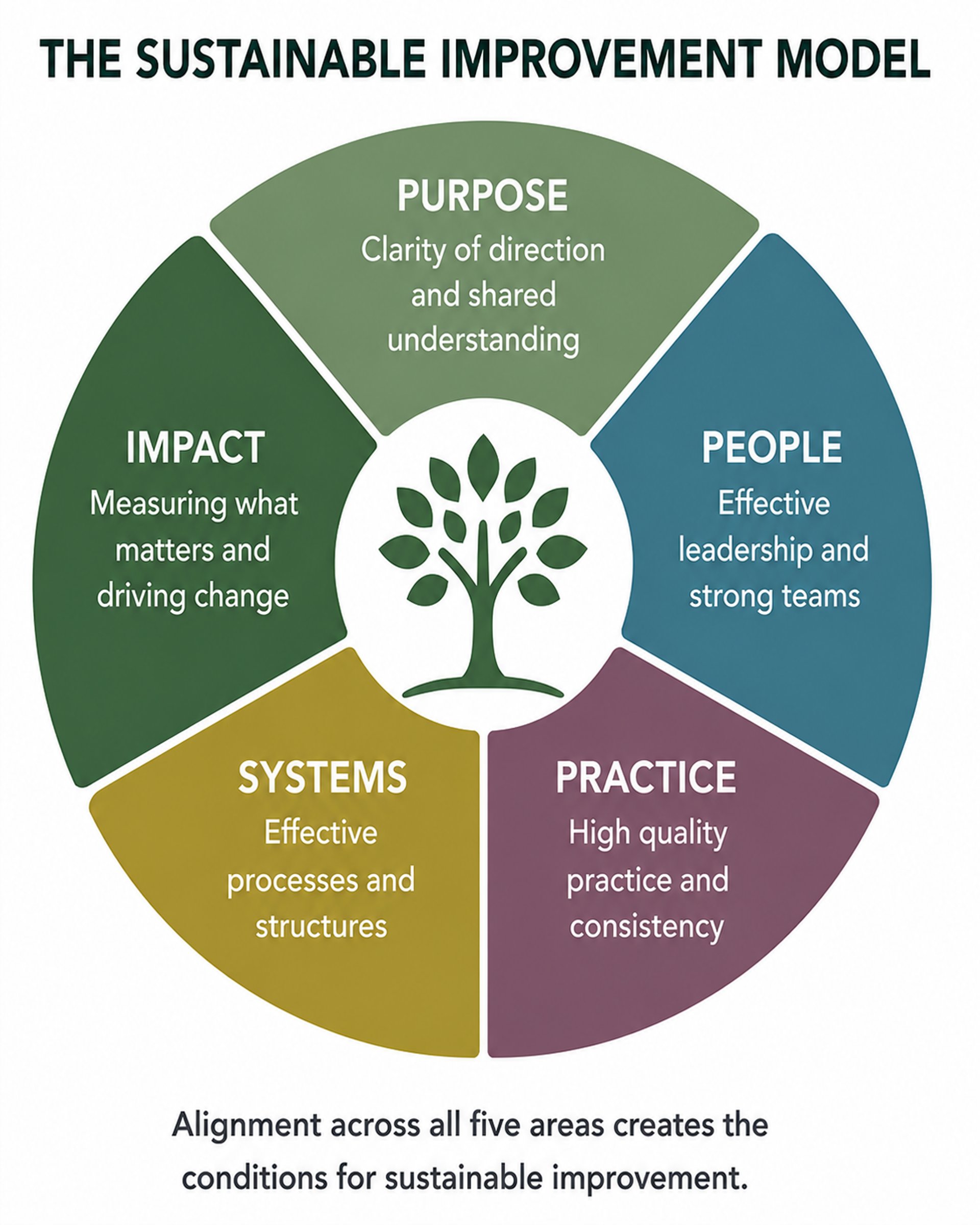
The framework encourages leaders to explore alignment across five interconnected areas before deciding what action to take. This helps organisations move beyond symptoms and focus on the areas most likely to create meaningful and lasting improvement.

Understanding the 5 areas
Purpose
Purpose provides direction. It is the reason improvement activity exists. When purpose is clear, staff understand priorities, decisions align with organisational goals and improvement activity feels meaningful.
Questions to consider:
1. Can staff explain organisational priorities?
2. Is there a shared understanding of what success looks like?
3. Do daily decisions reflect wider goals?
Impact
Impact is the evidence that improvement is making a difference. This includes staff confidence, practice quality, organisational effectiveness and outcomes for children and families.
Questions to consider:
1. How do we know improvement is happening?
2. What evidence supports this?
3. Are changes sustainable?
People
People are at the heart of sustainable improvement. This includes workforce capability, confidence, leadership, communication and professional development.
Questions to consider:
1. Do staff feel confident in their role?
2. Are leaders providing appropriate support and challenge?
3. Is CPD translating into practice?
Practice
Practice is where improvement becomes visible. This includes everyday routines, interactions, decision-making and implementation.
Questions to consider:
1. Is practice consistent?
2. Are expectations understood?
3. Are improvements becoming embedded?
Systems
Systems provide the structures that support improvement. Policies, procedures, supervision, quality assurance and communication processes all sit here.
Questions to consider:
1. Do systems support practice?
2. Are responsibilities clear?
3. Are systems helping or creating barriers?
Why alignment matters
The five areas do not operate independently. A challenge within one area often influences another.
For example:
A setting may identify inconsistent practice. The immediate assumption might be that staff need additional training. However, further exploration may reveal that staff understand expectations but are unclear about priorities, receive inconsistent supervision or lack opportunities to reflect on implementation.
In this situation, the issue may not be practice at all. It may be purpose, people or systems. This is why understanding alignment is so important.
How the framework works
Step 1: Identify
Use the Early Years Quality Improvement Diagnostic Toolkit to explore strengths, challenges and potential areas of misalignment.
Step 2: Understand
Review evidence, explore patterns and identify possible root causes.
Step 3: Prioritise
Focus on the area most likely to create meaningful impact.
Step 4: Act
Use the Sustainable Improvement Action Planner to create realistic, evidence-informed actions.
Step 5: Sustain
Review progress, embed change and continue building workforce capability over time.
Who is the framework for?
The framework has been designed for:
Nursery managers
Deputy managers
Leadership teams
Quality improvement leads
Childminder networks
Early years consultants
Training providers
Education organisations


Accessing the framework
Consultancy support
Move from diagnosis to meaningful action through structured planning and review.
Sustainable Improvement Action Planner
Early Years Quality Improvement Diagnostic Toolkit
Identify strengths, challenges and potential areas of misalignment.
Need support applying the framework within your organisation?
Sustainable improvement is rarely about doing more. More often, it is about understanding more.
When people understand their role, feel empowered to contribute and can see how their work connects to a wider purpose, improvement becomes easier to sustain.
The Sustainable Improvement Framework has been designed to support that process.